The Bottleneck Nobody Talks About
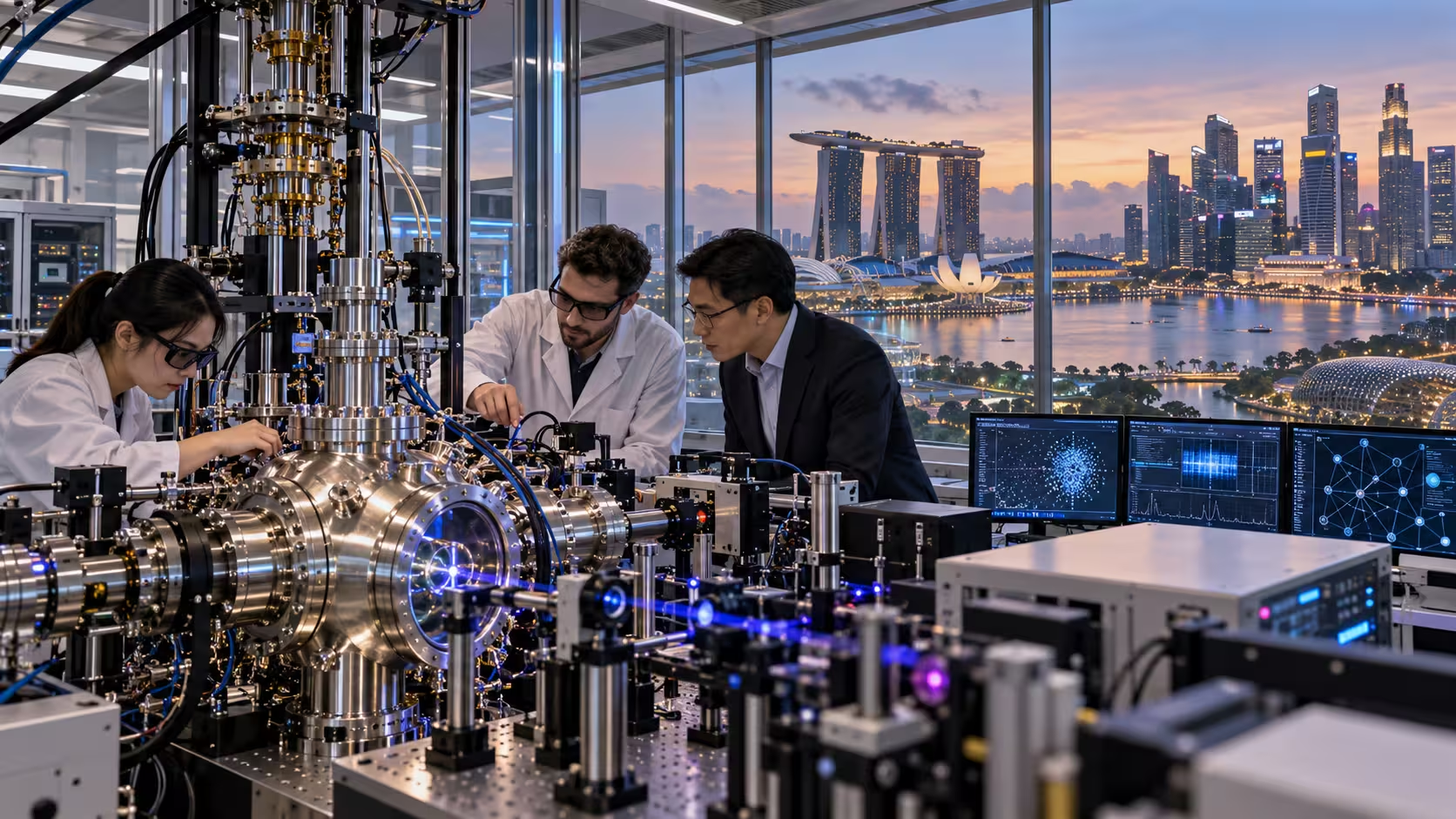
Quantum computing’s grand challenge is not just adding qubits — it is building the supporting infrastructure to make millions of qubits work reliably. Singapore has positioned itself at the center of this hardware problem, leveraging its semiconductor manufacturing heritage to solve the physical constraints limiting quantum processors.
In February 2026, Singapore’s National Quantum Federated Foundry (NQFF) announced a collaboration with Qolab, a quantum computing company co-founded by 2025 Physics Nobel Laureate Professor John M. Martinis. The partnership focuses on developing cryogenic low-pass filters, components that address a critical bottleneck in scaling quantum processors.
Why Cryogenic Filters Matter
Superconducting qubits — one of the most mature technologies for quantum processors — operate at temperatures near absolute zero and are extremely sensitive to environmental noise. Cryogenic low-pass filters act as shields, blocking unwanted high-frequency signals. Conventional filter solutions are large, error-prone, and difficult to mass-produce.
The NQFF-Qolab collaboration aims to manufacture these filters on semiconductor wafers, similar to conventional computer chip production. This approach enables denser integration of filters directly with qubit circuits, allowing more qubits in smaller, more reliable packages.
Universal Quantum’s Asian Manufacturing Base
In September 2026, UK-based Universal Quantum established its first R&D center outside Europe in Singapore, focusing on trapped-ion quantum computing technologies including ion-trap chip process development, integration, and advanced packaging. The center launched with an initial team of 25, backed by over SGD 30 million in investment, with EDBI, the investment arm of SG Growth Capital, as a strategic investor.
Universal Quantum’s longer-term roadmap targets fault-tolerant systems capable of addressing problems beyond today’s quantum machines. The Singapore work will include advanced ion-trap chip process development and integration, combining the company’s chip-design expertise with Singapore’s semiconductor fabrication capabilities.
Homegrown Innovation: AQSolotl and Quantum Control
Beyond attracting international players, Singapore is nurturing indigenous hardware startups. Researchers from Nanyang Technological University and the National University of Singapore developed quantum control technology commercialized through the startup AQSolotl. Control systems are an easily overlooked but critical part of quantum infrastructure — as machines grow, they require increasingly sophisticated control electronics that operate at cryogenic temperatures.
Tropical Challenges for Quantum Infrastructure
A unique challenge Singapore faces is its tropical climate. In June 2026, BW Digital and NUS launched a study examining how humid tropical environments affect the design and operation of quantum-ready data centers. Humidity management, heat rejection, vibration control, and electromagnetic stability present particular challenges in markets including Singapore and Batam. These environmental factors influence where quantum infrastructure can be placed and how facilities must be operated — a challenge that most quantum research hubs in temperate climates do not face.