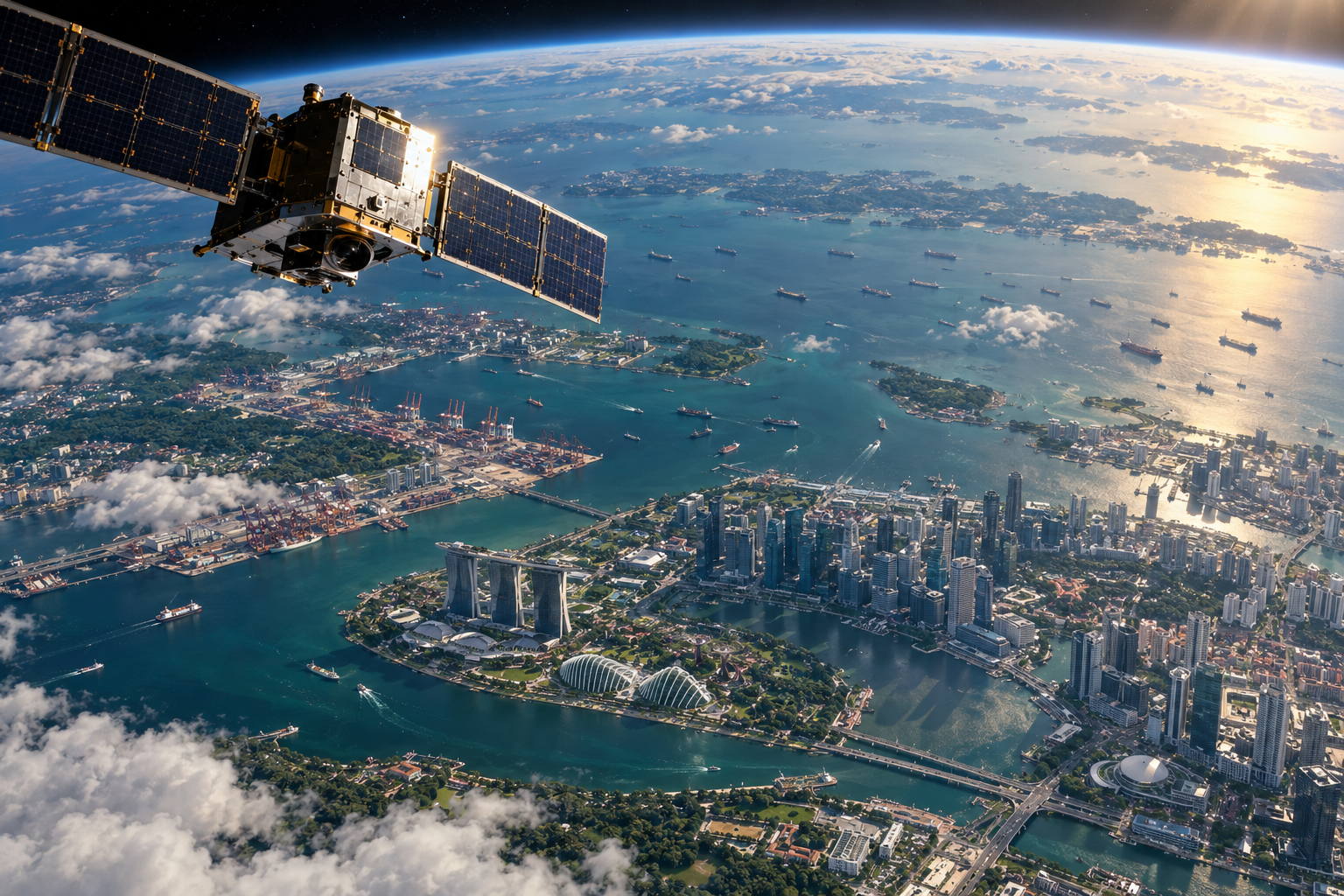
Singapore’s space technology industry is entering a new phase in 2026, with commercial opportunities increasingly extending beyond satellite manufacturing. Entrepreneurs are exploring how satellite imagery, artificial intelligence and advanced communications can support businesses in maritime transport, environmental monitoring, infrastructure management and financial services.
This shift is particularly important for smaller technology companies. Instead of competing directly with global rocket manufacturers, Singaporean startups can concentrate on satellite components, specialised software and data-driven services that address clearly defined market requirements.
National Space Agency Strengthens Industry Development
The establishment of the National Space Agency of Singapore on April 1, 2026, represents an important institutional milestone.
The agency has assumed the functions previously managed by the Office for Space Technology and Industry, expanding the country’s ability to coordinate satellite development, commercial partnerships and space governance.
Singapore already supports approximately 70 space-related companies and 2,000 professionals and researchers. Its existing strengths in microelectronics, engineering and artificial intelligence provide an industrial foundation for specialised space technology development.
The government’s strategy focuses on translating these capabilities into commercially relevant products while expanding opportunities for companies to participate in international satellite supply chains.
Earth Observation Offers a Growing Commercial Market
Satellite imagery provides valuable information for countries facing environmental and infrastructure challenges.
Across Southeast Asia, businesses and governments require updated information about flooding, coastal development, land-use changes and maritime activity. Satellite-based monitoring can complement traditional field surveys and provide coverage across geographically dispersed locations.
Singapore’s involvement in regional Earth observation projects illustrates this opportunity.
During the 2026 Space Summit, the government highlighted cooperation between the Earth Observatory of Singapore and the Mekong River Commission to develop flood-monitoring solutions.
The initiative demonstrates how space-based information can support practical regional needs.
Startups could build commercial products around similar applications by combining satellite imagery with predictive analytics, geographic information systems and customer-specific reporting tools.
AI and Advanced Satellite Systems Drive Innovation
Research institutions are also developing technologies that could make satellite operations more efficient.
In February 2026, Nanyang Technological University announced projects involving onboard artificial intelligence, satellite propulsion and advanced optical imaging.
Its planned AI-enabled nanosatellite, developed in cooperation with Satoro Space, is intended to process images directly in orbit.
By reducing the amount of raw information transmitted to ground stations, onboard processing could lower operational burdens and accelerate the delivery of actionable observations.
Singaporean companies also operate in emerging communications technologies. SpeQtral’s quantum communications satellite entered its experimentation phase in August 2026, demonstrating ongoing efforts to develop specialised satellite-based connectivity.
Funding and Research Partnerships Support Startups
The Space Technology Development Programme is an important part of Singapore’s industry strategy.
According to the NSAS programme information updated in July 2026, S$210 million had been secured by 2025 to support space technology innovation.
The programme includes support for technology development, feasibility testing and access to orbital experimentation.
These mechanisms help researchers and businesses validate new technologies, although participation depends on project requirements and technical assessment.
Commercial Success Requires More Than Satellite Access
Space startups must establish dependable revenue models rather than relying exclusively on technological breakthroughs.
Data accuracy, processing costs, cybersecurity and access to satellite infrastructure remain significant considerations.
Companies that integrate satellite information into existing business workflows may have a stronger route to commercial adoption.
For Singapore, the emerging opportunity is therefore not simply launching additional spacecraft. It is building competitive businesses that translate space technology into valuable services for customers throughout Asia.