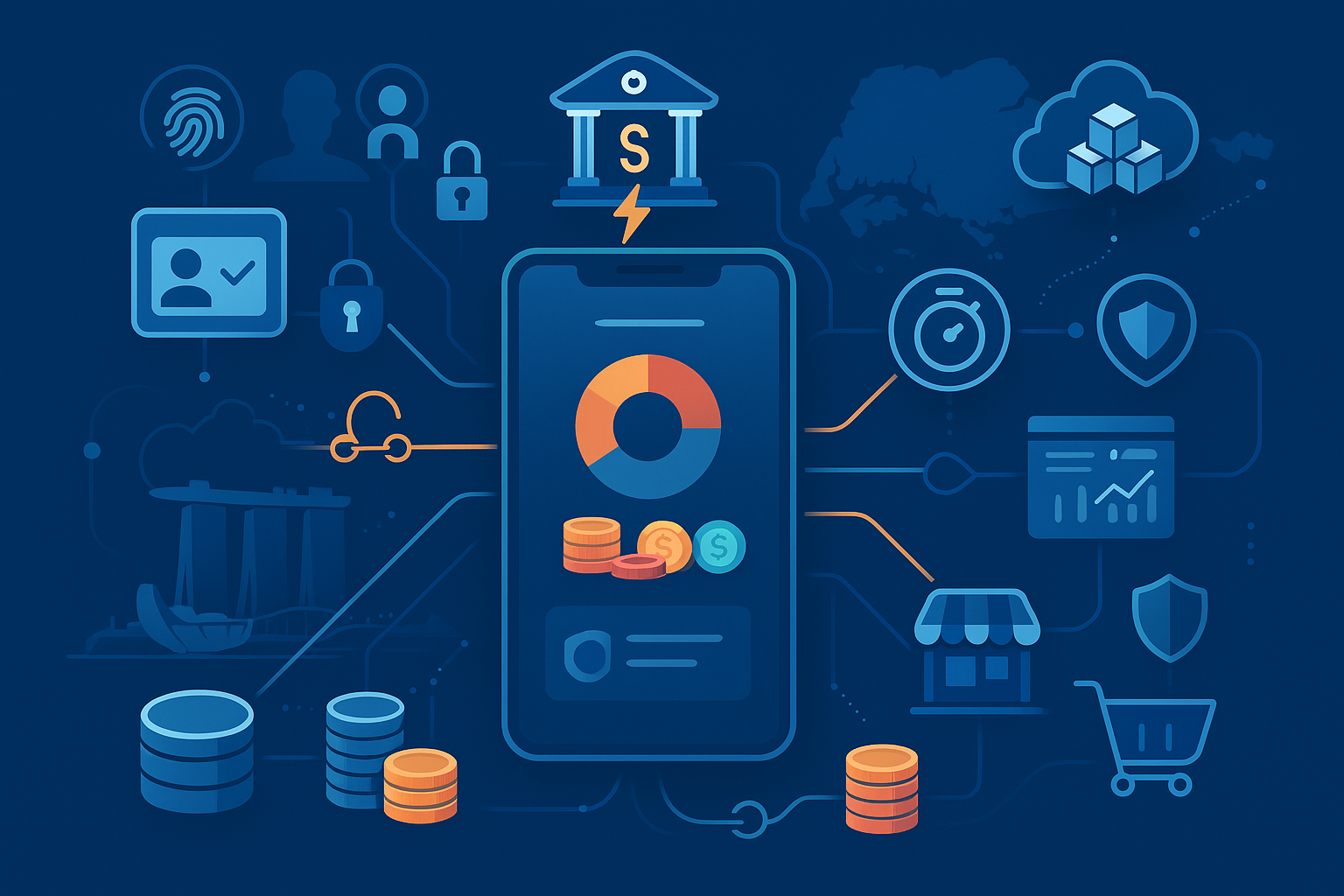
Singapore’s move to digital banking is built on three layers: infrastructure, regulation, and experience. Infrastructure includes near-universal mobile coverage and real-time rails like FAST and PayNow that normalize instant value transfer. Regulation comes from MAS, which introduced tailored licences for digital full and wholesale banks and codified expectations around technology risk, outsourcing, and AML/CFT. Experience is the layer customers touch, shaped by clean UI, transparent fees, and instant service.
Onboarding exemplifies the shift. With Singpass/Myinfo and eKYC, customers can authenticate identity, capture documents, and verify liveness in minutes. Banks then personalize dashboards—showing spend patterns, cash flow projections, and nudges to build emergency funds. For SMEs, digital KYC and business data ingestion accelerate access to credit and payments without waiting for paper reviews.
Security is continuous rather than episodic. Device fingerprinting, behavioral biometrics, and anomaly detection provide defense in depth. High-risk actions trigger step-up authentication, while dynamic risk scoring can throttle transaction limits until confidence rises. Banks complement these controls with proactive scam prevention—limiting suspicious payees, adding confirmation friction, and offering emergency account locks.
Under the hood, cloud-native cores and microservices enable rapid iteration. Teams push small, frequent releases while feature flags allow safe rollouts. Observability tools feed telemetry into risk systems and product analytics, so both compliance and UX benefit from the same data nervous system. Model governance ensures that ML-driven underwriting and fraud detection are explainable and auditable.
Ecosystem connectivity is a force multiplier. SGFinDex supports consolidated financial views and consented data flows. Open APIs let third parties embed bank capabilities into point-of-sale, logistics, and gig platforms, creating contextual offers—like working-capital top-ups when inventory runs low, or travel insurance at checkout. Embedded finance reduces acquisition cost and places services where decisions happen.
Competition shapes the pace. Incumbent banks lean on balance-sheet strength and enterprise-grade reliability, while new digital entrants focus on speed, clarity, and underserved segments. Consumers now expect instant account opening, fee transparency, and low-friction international payments. SMEs expect next-day, even same-day, credit decisions with seamless collection options.
As a regional hub, Singapore tests ideas with global relevance. Multi-currency accounts, cross-border instant payment corridors, and experiments in purpose-bound money point to a future where funds carry programmable constraints. That could rewire payroll, grants, and B2B disbursements, making reconciliations automatic and misuse harder.
Will branches disappear entirely? Probably not for wealth planning and large corporate engagements, where human advice and complex documentation remain valuable. But the default touchpoint is decisively digital. The office-less bank succeeds when every interaction—on a phone, inside a partner app, or through an API—feels trustworthy, quick, and easy, with governance embedded so safety scales alongside innovation.