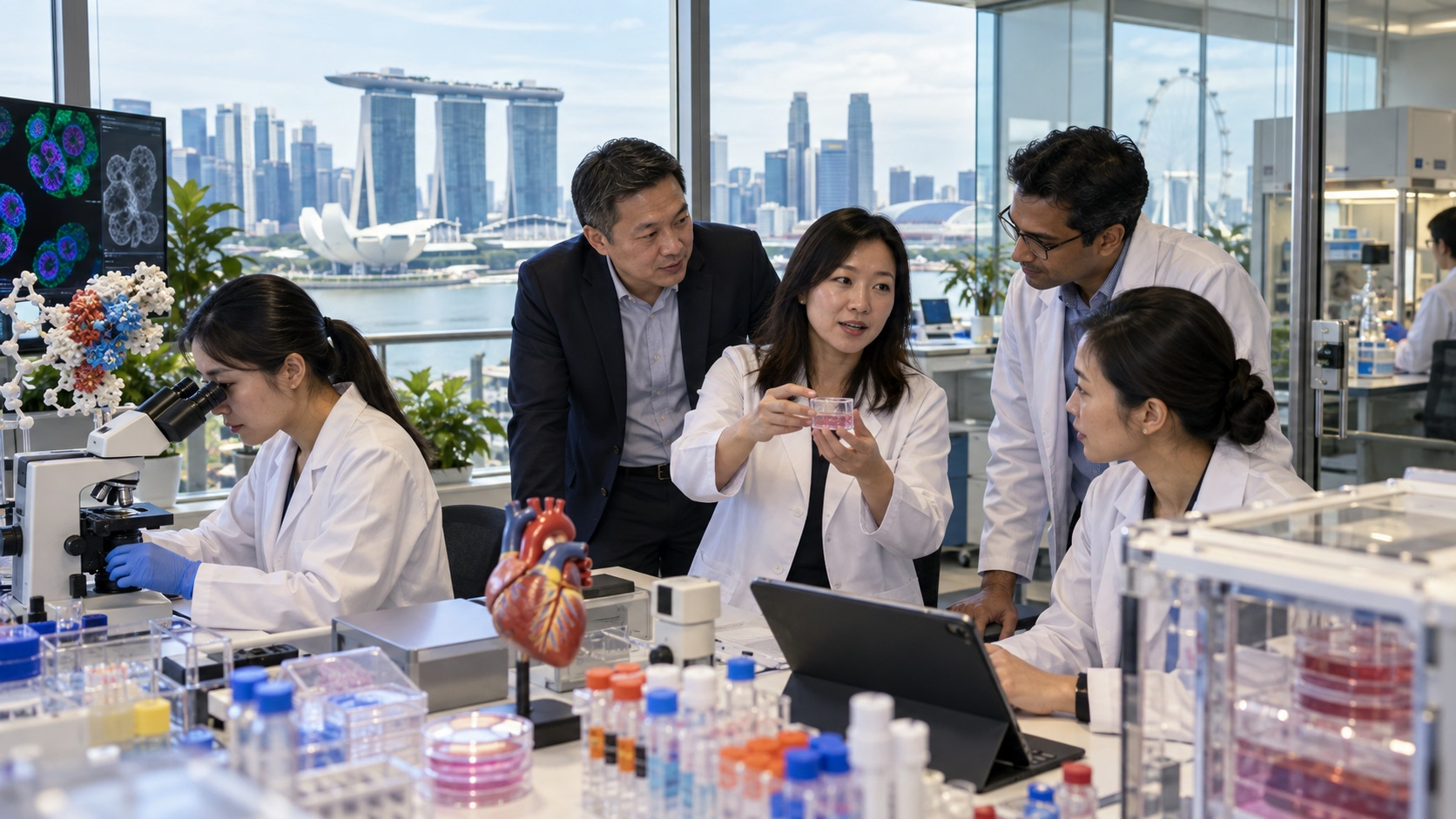
When Biology Becomes a Factory
The global bioeconomy is projected to contribute up to US$4 trillion annually within the next decade, driven by a fundamental shift away from petrochemical-based production toward biological systems that can manufacture ingredients, chemicals, and materials more sustainably. Singapore has positioned itself at the centre of this transition—not merely as a consumer of bio-based products, but as a developer of the platforms that make them possible.
In June 2026, the Agency for Science, Technology and Research (ASTAR) and the National University of Singapore (NUS) launched a joint laboratory designed to accelerate the translation of synthetic biology research into commercially viable applications. The ASTAR SIFBI-NUS Synthetic Biology Joint Lab represents a deliberate attempt to close the gap between laboratory discovery and industrial deployment.
The Three Pillars of Translation
The joint lab’s strategy rests on three interconnected objectives. First, faster design: AI-guided enzyme and pathway engineering to compress development timelines. Second, scalable production: industrially deployable microbial platforms capable of producing complex molecules at commercial scale. Third, new molecules: access to novel bio-based compounds for ingredients and functional applications.
Led by Professor Jay Keasling, a pioneer in synthetic biology whose work has already demonstrated the commercial viability of engineering microbes to produce artemisinin (an anti-malarial drug), the lab brings together A*STAR SIFBI’s capabilities in bioprocess development and scale-up with NUS’ strengths in fundamental science and interdisciplinary research. The initial focus on nutrition and consumer care reflects market demand: companies are actively seeking sustainable alternatives to conventional chemical manufacturing, and the lab aims to co-develop and validate these solutions with industry partners.
Beyond the Lab: Singapore’s Biomanufacturing Infrastructure
The joint lab does not operate in isolation. Singapore has spent decades building the physical and human infrastructure required to support a thriving bioeconomy. The nation now houses over 60 plants dedicated to bio-based products, attracting more than S$4 billion in investments in 2025 alone. The Biopolis campus in one-north provides an integrated research environment, while the Tuas Biomedical Park offers purpose-built facilities for manufacturing scale-up.
This infrastructure is critical because synthetic biology’s promise—replacing petrochemical processes with biological ones—can only be realised if production can be scaled economically. The gap between demonstrating a pathway in a flask and producing tonnes of material in a bioreactor is where many promising technologies fail. Singapore’s investment in bioprocessing research at A*STAR’s Bioprocessing Technology Institute (BTI) addresses this challenge directly, developing the automation, analytics, and process design capabilities needed for commercial-scale production.
The Strategic Logic
Singapore’s approach to synthetic biology reflects a broader strategic logic. The country lacks the agricultural landmass or cheap energy resources that might give other nations a natural advantage in bio-based production. Instead, it competes on intellectual property, process innovation, and regulatory clarity. By investing in the tools and platforms that enable bio-based manufacturing—rather than just the products themselves—Singapore positions itself as essential infrastructure for the global bioeconomy.
The joint lab’s industry-facing model, where companies can co-develop and validate sustainable alternatives, is particularly significant. It lowers the barrier for established manufacturers to adopt bio-based processes, potentially accelerating the transition away from petrochemical dependence across multiple industries.
As global demand for sustainable production methods intensifies, the ability to design, scale, and commercialise biological manufacturing processes will become a source of competitive advantage. Singapore’s investment in this capability suggests it intends to be a primary beneficiary of that shift.